Dog To Human AI Transformations: How AI Is Revealing Your Dog's Secret Human Identity 💭
The viral dog to human AI trend isn't just fun—it's tapping into something ancient and deeply human about our connection with our pets.
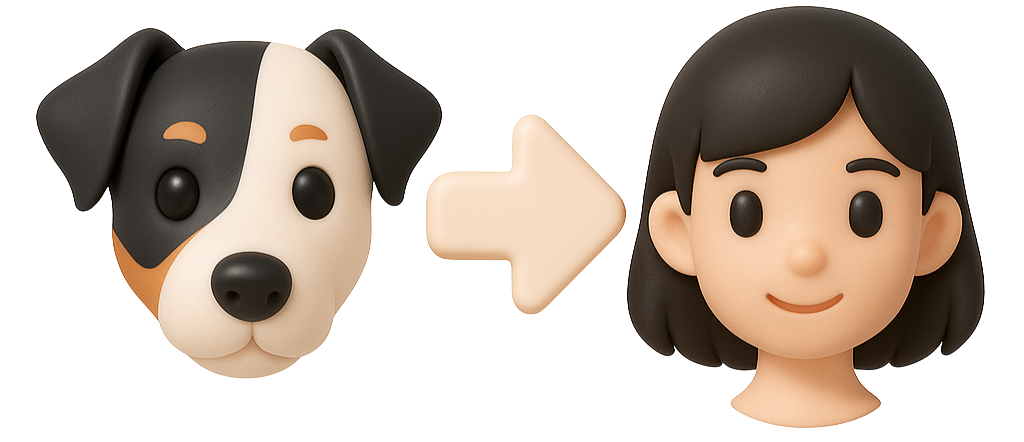
The viral dog to human AI trend isn't just fun—it's tapping into something ancient and deeply human about our connection with our pets.
There's a moment every dog owner knows intimately. You're sitting on the couch, your dog curled beside you, and they look up with an expression so unmistakably knowing that you find yourself thinking: If you could talk, who would you be?
For centuries, that question lived only in our imaginations. We'd wonder if our gentle Golden Retriever would be a warm-hearted grandfather type, or if that mischievous Chihuahua had the soul of a punk rock teenager. Now, thanks to a viral AI trend sweeping TikTok and Instagram, we're getting answers—and they're surprisingly, sometimes eerily, accurate.
The dog to human AI phenomenon has captured millions of pet owners' hearts since exploding on social media in April 2025. Using artificial intelligence image generators, people are transforming photos of their beloved dogs into hyper-realistic portraits of what their pets might look like as humans—complete with personalities that seem to leap off the screen.
The Ancient Magic of Transformation
Long before AI could turn your Labrador into a lumberjack-looking gentleman with kind eyes, humans have been obsessed with the idea of transformation between species. This fascination runs through the oldest stories our species has ever told.
In Greek mythology, the god Zeus famously transformed into a swan, a bull, even an ant. The goddess Circe turned Odysseus's men into pigs in Homer's The Odyssey—one of our oldest surviving works of literature. The concept appears in the Epic of Gilgamesh, in Norse legends of the trickster god Loki, and in Japanese folklore with the kitsune, magical foxes who could take human form.
Modern fiction has kept this tradition alive and thriving. Perhaps no literary example resonates more with dog lovers than Sirius Black from J.K. Rowling's Harry Potter series. Sirius, Harry's godfather, is an Animagus—a wizard who can transform at will into a large black dog. What makes this character so beloved isn't just his magical ability; it's how perfectly his dog form reflects his human personality. Sirius exhibits classic canine traits: fierce loyalty, a protective nature toward his loved ones, and an almost desperate need to be part of a pack. Even his name comes from the Dog Star, the brightest star in the night sky.
Sarah J. Maas's bestselling Throne of Glass series features Lysandra, a shapeshifter who can transform into any animal or human form. Her preferred form? A ghost leopard—and her personality in human form mirrors that feline grace and fierce independence. The Fae characters in Maas's world each have animal forms that correspond deeply to their inner nature, from hawks to wolves to mountain lions.
K.A. Applegate's Animorphs series, which ran from 1996 to 2001, took this concept to young adult readers with teenagers who could morph into any animal they touched. The series sold over 35 million copies, tapping into that universal desire to understand the animal world from the inside. Twilight's werewolves, the Earthsea wizards who risk losing themselves in animal forms, countless fairy tales where princes become frogs—the theme persists because it speaks to something fundamental in us.
The Spirit Animal Connection
The concept of spirit animals—creatures whose traits mirror our own personality—has existed across cultures for millennia. Native American traditions speak of animal totems that guide and protect. Chinese astrology assigns animal years that supposedly shape personality. The ancient practice of animism holds that everything in nature possesses a spirit or life force.
Modern psychology has embraced this connection too. Carl Jung's work on archetypes includes universal animal symbols that resonate across human experience. Research suggests we're drawn to animals that reflect qualities we see—or wish to see—in ourselves. It's why personality quizzes asking "What animal are you?" remain endlessly popular online.
But the dog to human AI trend flips this ancient question on its head. Instead of asking "What animal am I?", we're asking "What human is my dog?" And that reversal is precisely what makes it so compelling.
For dog owners, this isn't mere curiosity—it's a quest for deeper understanding. We already believe we know our dogs' personalities intimately. We describe them to friends: "Oh, she's such a drama queen" or "He's an old soul." The AI transformation gives those intuitions a face, and when it works, the recognition is immediate and profound. That grumpy Pomeranian really does look like a fierce elderly woman with wild orange hair. Your gentle Great Pyrenees would be that soft-spoken bearded man in a cozy sweater.
The Science of Why Dogs Look Like Their Owners
Here's where the dog to human AI trend intersects with actual scientific research—and the findings are fascinating.
A systematic review of 15 studies published in Personality and Individual Differences in 2024 confirmed what many have long suspected: dogs really do resemble their owners, both in appearance and personality. In multiple studies, participants could correctly match photos of dogs to their owners at rates significantly better than chance. One remarkable study found that people could make accurate matches using only the eye region of both dogs and owners.
The research found correlations between owners' hair length and their dogs' ear length, between the weight of dogs and their owners, and most strikingly, between personality traits. Dog owners rated their pets as having similar personalities to themselves across all five major personality dimensions, with the strongest associations in extraversion and neuroticism.
Scientists explain this through the "Mere Exposure Effect" and "Preference for Self-Similarity"—we're unconsciously drawn to dogs that remind us of ourselves. But there's also evidence that dogs and owners grow more alike over time, perhaps through mutual emotional regulation and behavioral reinforcement, much like long-married couples.
This scientific backdrop is what makes the dog to human AI transformations so satisfying. When you see your dog's "human version" and feel that flash of recognition—"Yes, that's exactly who he is!"—you're experiencing the visual manifestation of a connection science has documented. The AI is seeing patterns that actually exist.
How the Viral Trend Took Over TikTok
The dogs into humans AI trend exploded seemingly overnight in April 2025, following a series of other viral AI image trends—first the Studio Ghibli-style portraits, then the action figure boxes. But the pet transformation trend hit differently. It felt personal in a way those other trends didn't.
CBS Mornings featured the trend with a segment showcasing the most memorable transformations. Tech influencers demonstrated the technique to millions of followers. One video of a sweet Pomeranian transformed into a wild-looking elderly woman went viral with millions of views, as viewers marveled at how the AI captured not just the dog's physical features but its apparent personality.
Celebrity pet owners joined in too. Reality star Bethenny Frankel shared her dogs' transformations, declaring the results had made her "an AI believer." Families began sharing their dog-human portraits like proud parents showing off yearbook photos.
What makes these transformations so shareable isn't just novelty—it's the emotional truth they seem to capture. A British Bulldog becomes a leather-clad woman in a rock band t-shirt. A white-furred senior dog transforms into a distinguished elderly gentleman. An energetic puppy becomes a bright-eyed young person with infectious energy. The AI isn't just changing species; it's translating personality across forms.
Beyond ChatGPT: Specialized Apps for Better Results
While the trend started with ChatGPT, many pet owners have discovered that getting truly impressive dog to human AI results requires more than basic prompting. ChatGPT's free tier limits users to just three image generations per day, and the results can be inconsistent without carefully crafted prompts.
The basic approach works well enough: upload a clear photo of your dog, specify their gender, and ask what they'd look like as a human. ChatGPT might ask follow-up questions about personality, age, and style before generating the image. But serious pet portrait enthusiasts are discovering that specialized apps deliver more reliable, detailed results.
Apps like Dog 2 Human have emerged specifically for this purpose, promising "expertly crafted AI prompts" that produce more accurate translations of canine features into human equivalents. These specialized platforms claim to have developed "secret recipes" of prompts that better capture the nuances of individual dogs' personalities and physical traits. Other tools like EaseMate AI offer similar functionality, analyzing expressions, postures, and even accessories before generating human counterparts.
The key difference? Detail. Basic prompts might capture fur color, but specialized systems aim to translate subtler features—the way a dog holds its ears, the expression in its eyes, even its apparent energy level. For pet owners seeking the most accurate "spirit human" of their beloved companion, these dedicated tools offer something the basic ChatGPT approach can't match.
What the Transformations Reveal About Our Pets—and Ourselves
There's something profound happening beneath the surface of this playful trend. When we use AI dog to human technology, we're not just creating amusing images—we're seeking confirmation of something we've always believed: that our dogs are individuals with distinct personalities worthy of recognition.
The transformations tend to preserve what we intuitively understand about our pets. Active, energetic dogs become bright-eyed young humans. Dignified, calm dogs become composed, thoughtful-looking people. Anxious dogs often translate into humans with worried expressions. The AI is picking up on visual cues that we recognize as personality—posture, eye expression, the set of the mouth or ears.
This mirrors the Animagus concept from Harry Potter, where a wizard's animal form reflects their inner self. Sirius Black's dog form embodies loyalty and protection. James Potter became a stag, noble and proud. Peter Pettigrew—the traitor—was a rat. The idea that our animal forms reveal our true nature is ancient wisdom that AI is now making visible in reverse: showing us the human nature hidden within our animal companions.
For many owners, seeing their dog's "human version" creates an unexpected emotional response. It's one thing to anthropomorphize your pet internally, imagining their thoughts and feelings. It's another to see a face that captures those imagined qualities—to feel, for a moment, that you finally understand who your dog really is.
The Future of Understanding Our Furry Friends
The dog to human AI trend isn't just a passing social media fad—it's the latest expression of humanity's oldest desire to bridge the gap between species. From the cave paintings at Trois-Frères showing figures that are part human, part animal, to the shapeshifters of mythology, to Sirius Black transforming under the moonlight, we've always yearned to understand the animals we share our lives with.
What's remarkable about this AI-powered moment is how democratic it's become. You don't need to be a wizard, a shaman, or a mythological god to glimpse your pet's "human" self. You just need a smartphone and a good photo of your dog. The magic that once belonged only to fiction and folklore is now available to anyone willing to upload an image and ask the question: "Who would you be?"
And when that AI-generated face appears—perhaps with your Golden Retriever's warmth translated into gentle eyes, or your terrier's feistiness captured in a determined jaw—you might find yourself nodding in recognition. Because you always knew, didn't you? You knew who they were inside. The AI just finally gave that knowledge a face.
So try it for yourself. Upload that favorite photo of your dog. Ask the AI to show you their human self. You might laugh, you might cry, you might immediately share it with everyone you know. But one thing's certain: you'll never look at your four-legged friend quite the same way again. Because now you've seen their spirit human—and they've been waiting for you to meet them all along.
Curious about your dog's age in human terms? Use our dog to human years calculator to find out exactly how old your furry friend would be as a person.
How to Try the Dog to Human AI Trend
Using ChatGPT: Upload a clear photo of your dog, specify their gender, and ask "What would my dog look like as a person?" ChatGPT may ask about personality traits before generating the image.
For Best Results: Use a high-quality, well-lit photo showing your dog's face clearly. Include details about their personality, age, and any distinctive quirks. Consider specialized apps like Dog 2 Human or EaseMate for more refined prompts.
Free Tier Limits: ChatGPT's free version allows approximately three image generations per day, so choose your photos wisely!
Further Reading & Resources
- Tom's Guide: How to Turn Dogs Into Humans Using ChatGPT
- National Geographic: Dogs and Their Owners Really Do Look Alike
- Psychology Today: Do Owners and Their Dogs Have Similar Personalities?
- Like Owner, Like Dog: A Systematic Review (2024)
- Wikipedia: Shapeshifting
- Harry Potter Wiki: Sirius Black
- Throne of Glass Wiki: Shape-shifters
- Wikipedia: Animorphs
- Dog 2 Human App